Navy veteran’s trip to the animal shelter changed his life forever
Maria feared the darkness consuming her husband as Otter faced a grim reality that grips all kinds of service members like him.
(WVUE) - A Navy Veteran facing an uncertain future found hope in an unlikely friend.
A visit to a Louisiana animal shelter changed his life forever and is now laying the foundation to help many more.
People have relied on dogs for ages, padding a foundation for a bond that creates a keen understanding of how we live.
“They’ve always kind of been our helpers,” said Master Trainer at KProp K9, Evan Stewart. “For over 35,000 years.”
“Dogs can hear your heartbeat outside your chest... smell your pheromone response in real-time.”
Stewart knows that bond builds unwavering loyalty.
“They give us that best friend,” he said. “That constant support in our lives.”
Dogs can be the glue in our lives, but often, they need us just as much.
The Northshore Humane Society houses dogs year-round, heartbreakingly lonesome pets seemingly desperate for a home and a family. At any time, CEO Scott Bernier says they could have between 180 and 200 animals under their care.
“We do everything we can to get them adopted, but sometimes it doesn’t happen,” Bernier said.
Volunteers take time out of their days to spend time with the animals walking, socializing, and sometimes visiting overnight.
Maria Obst’s lotto ticket was Kimber, a stray, looked over until she and her husband Lawrence started volunteering at the shelter.

“He was amazing,” Maria said. “He was in the shelter for six months and we’re like ‘we hit the jackpot.’”
“The first weekend I was there I ran into Kimber who was ‘Teddy’ at the time,” Lawrence, who goes by Otter, said. “We believe him to be a Dutch Shepherd.”

Otter and Kimber bonded quickly. A bond Maria was desperate to see in her husband, a 28-year veteran of the U.S. Navy forced into early retirement.
Otter spent nearly 30 years in Naval Special Operations, 14 deployments, six of which were in hazardous combat areas, ultimately reaching the rank of Chief Warrant Officer. It’s where he met his wife 27 years ago. The Navy is his life.
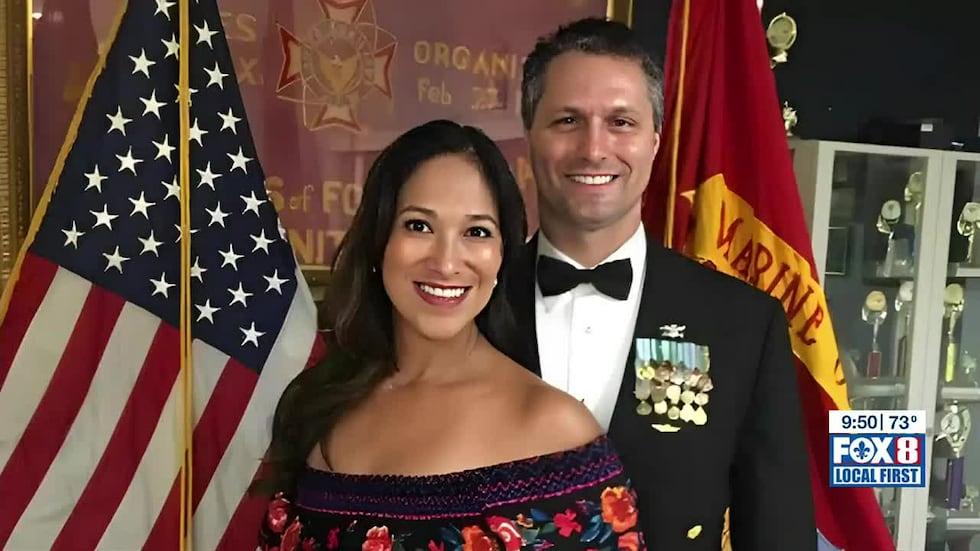
But after a mid-air collision and a 30-foot-fall, on top of previously sustained injuries, his career and his life came to a screeching halt.
“I remember the doctor coming in and asking me when I retiring,” Otter recalled. “He goes ‘we’re not allowing you to get back to an operational command. You have mild to severe TBI. You’re suffering from vestibular balance disorder.’”

“I wear hearing aids in both ears now and I have cognitive memory issues,” he continued.
His future in the Navy fading, Otter’s regiment of at least a dozen different medicines, and now hounding disabilities, gripped his life.
“I was suffering. I was suffering from depression, anxiety, and frustration. I was withdrawing from my last deployment in Iraq and Syria in 2018 and I started having mood issues, withdrawing from functions with family,” Otter recalled.
“These last couple years have been tough,” Maria said. “He struggles with his disabilities and also his depression, his PTSD.”
Maria feared the darkness consuming her husband as Otter faced a grim reality that grips all kinds of service members like him.
“The thing that haunts me the most are all the deaths,” he said. “I started really dwelling and thinking of my lost colleagues and teammates.”
According to varying statistics, more than a dozen service members commit suicide every day. A stark number that’s often estimated as high as 22 a day.

“Last year a dear friend of mine, a young man that I put through selection - great husband, great wife, great children, wound up succumbing to suicide... to the paint and suffering,” Otter said. “Losing all of these teammates... it starts to take a toll on you. It starts making you question your... your purpose.”
“In the veteran community, 22 a day is a real thing and one of the things that we are really trying hard to do is stem the tide of losing our men and women from service who come home and they’re different than they left,” Stewart said.
“Something had to give,” Maria said. “I knew I couldn’t be the person he needed, but no matter what I did, something else had to happen.”
That something else just so happened to need a little help, too.
“I got dizzy a couple times and [Kimber] came into the picture and got really close to me and just started bracing me as I wobbled and one of the ladies comes out and says ‘you know you can the dogs home as a volunteer,’” Otter said.

Eager to foster, Maria got the ball rolling, even as Otter refused.
“I knew if I signed him out he was not coming back to the shelter,” Maria said.
By Valentine’s Day, Teddy had a new home, a new name, and a new purpose. Otter did, too.
“He picked me,” Otter said of Kimber. “I like to say I picked him but he shopped for the right owner.”
Almost immediately, Otter and Kimber started training together at their home in Picayune, Mississippi, ambitious to take the next step of formally certifying Kimber as a service animal.
They enlisted Stewart and KPro K9.

Stewart put Kimber on a training plan; tasks he and Otter would complete at home, restaurants, and at the store. Within months, Kimber was certified as a mobility service dog, specially trained to provide critical support.
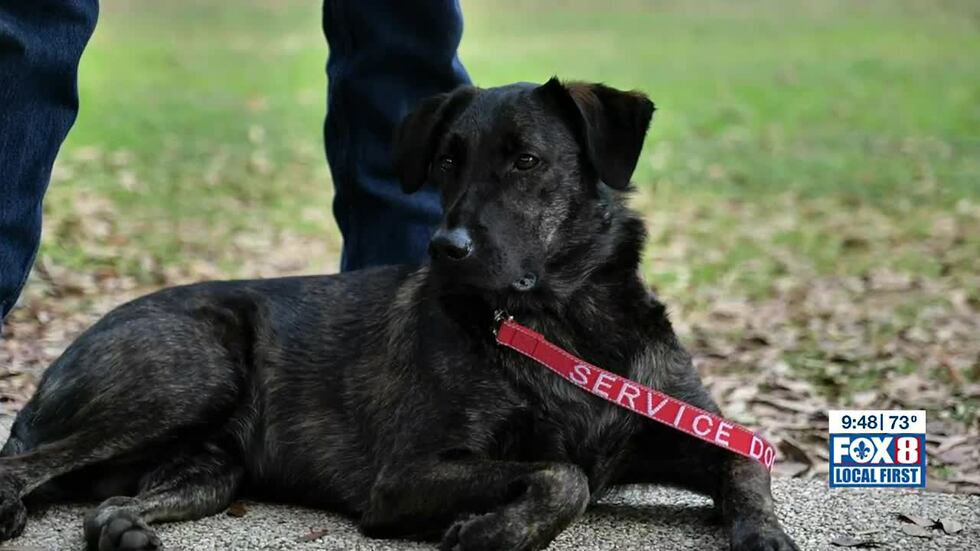
“Kimber is trained that he can support, embrace. So as I go to get up I can put my full weight on him. He also braces in between my legs as I’m losing my balance,” Otter said. “It’s like having a cane but instead of having a clumsy cane I have a canine.”
That support goes beyond the physical aspect. As their bond strengthened, Otter found Kimber’s presence helped brighten that once bleak view of his future.
“Kimber just changed his life,” Maria said. “He changed our lives but he’s more than just a dog.”
Over the course of the year, Otter’s prescription meds dwindled from a dozen to just four. It appeared Kimber was just what Otter’s doctor ordered.
“He said Kimber was the best medicine that he could have ever... he couldn’t prescribe a medication if he is he meeting those roles,” Otter said.
By his side, Kimber goes to physical therapy with Otter, work, and lunch. He even has a special job when they pick up meds at the drugstore.

“I’ll give him my medication with the receipt and he carries it just so confidently out of the store all the way to the vehicle,” Otter described.
“Here’s a veteran that needed just a little extra support to thrive in his community and with a good dog by his side he’s been able to do just that,” Stewart said.
Kimber’s impact in Otter’s life created a ripple effect.
“When I first saw the training, how far Kimber had evolved in the short period of time, I was blown away,” Bernier said. “It hit me that there was an opportunity to take animals in the shelter and partner with someone like KPro and turn them into service dogs.”
Inspired by Otter and Kimber, Bernier and Stewart created the Shelter to Service program, identifying dogs for advanced service training and effectively eliminating the need for a specially bred dog that can cost tens of thousands of dollars.

“We want a dog who will really want to be loved and be in a relationship with others,” Stewart said. “There is no breed type. That idea, that iteration of a dog, comes in all breeds, all shapes, all sizes.”
The program is already benefitting the community and clearing space to rescue more animals. Mrs. B, a rescue, was the first graduate of the program, paired with another Navy veteran.
“You are not only saving a dog’s life in this particular situation with our Shelter to Service program,” Stewart said. “But you are most often at least enabling a life to thrive in a human being, if not saving their life for sure.”
As Otter faces retirement in March, his confidence in what life will look like outside of the Navy is growing.
“If I can’t take Kimber with me it’s not worth doing,” he said. “With him in my life, our lives are better.”

Maria has seen it first hand. For her, Kimber is much more than a cane or medicine, he’s a rescue who needed a little help but offered a lifeline when her husband needed it most.
“There were times he just struggled to get out of bed,” she recalled. “Struggled to get off the couch. With Kimber, he had somebody else. Kimber relied on him. They relied on each other and I believe they saved each other.
The Northshore Humane Society plans to train at least four service dogs this year and ramp up the program in 2024.
A similar service dog can cost as much as $50,000. But thanks to KPro K9 and the Humane Society, they’ll be able to pair the Shelter to Service animals with people in need for about $1,000.
The Humane Society hopes to find an underwriter to continue to fund and eventually expand the program.
See a spelling or grammar error in our story? Click Here to report it. Please include the headline.
Copyright 2023 WVUE. All rights reserved.