How to forecast the different winter weather types
Winter can bring frozen precipitation, but it’s not all created the same.
NEW ORLEANS (WVUE) - It’s that time of year when Arctic air outbreaks are more likely - and when that cold air meets moisture, it makes winter weather.
However, not all frozen precipitation is created the same way.

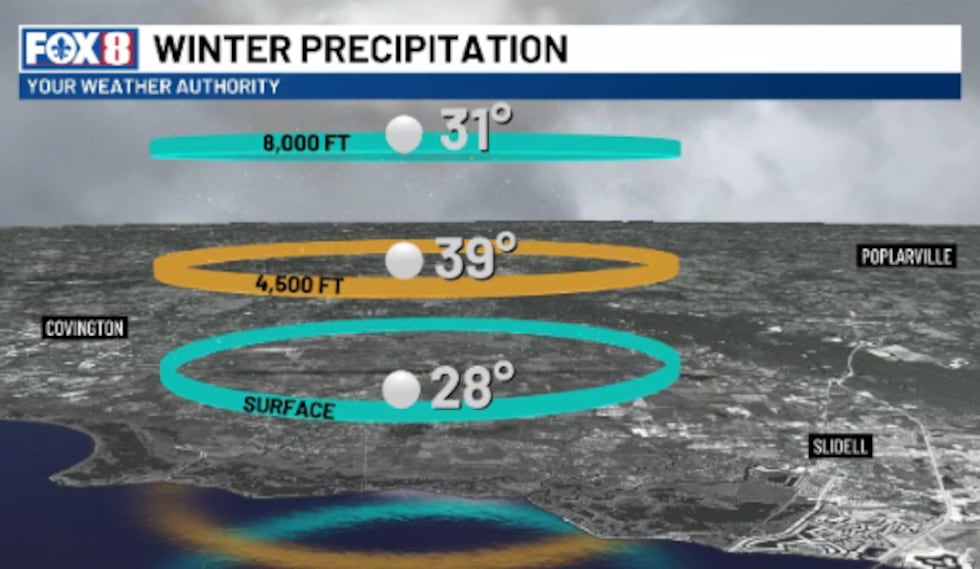
The atmosphere from the surface to the top is not uniform. The temperature varies with each layer.
These temperatures determine what type of winter precipitation we see here at the surface.
READ: Winter storm potential growing for next week
Snow is only made in the clouds, that’s an important fact to remember. The atmosphere it falls through dictates what happens to that snow.
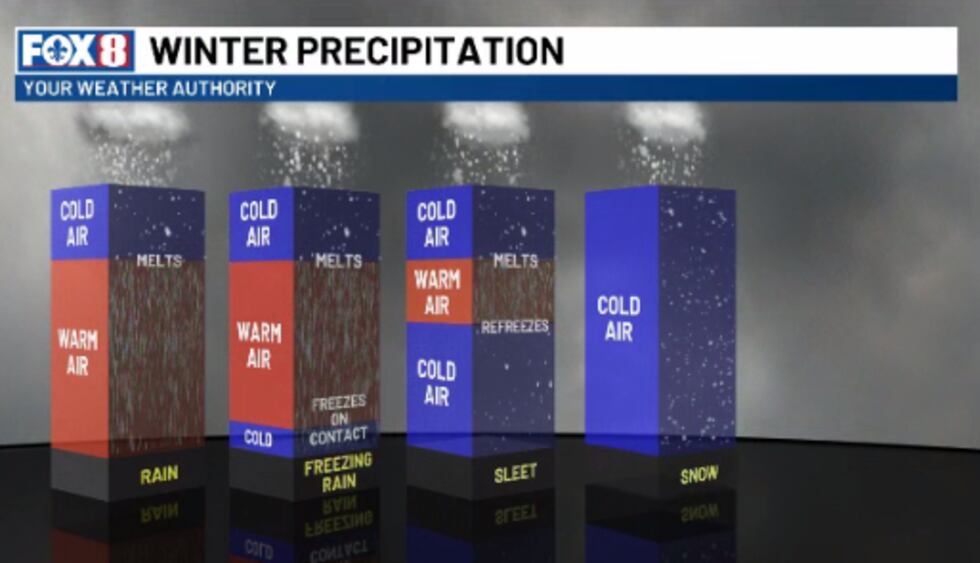
When the snow falls through an atmosphere with all temperatures above freezing, it melts to become rain.
But things get a little more complicated when we introduce more cold air.
Let’s say the snow falls through a warm layer... It then completely melts but hits freezing temperatures at the surface. This is considered freezing rain.
It happens when supercooled raindrops freeze to objects like cars and roads on contact. And this is what creates ice storms.
IMPORTANT LINKS
- Download the Fox 8 Weather App + Download the Fox 8 News App
- Track weather in real-time with VIPIR radar.
- View Entergy power outages here - all other providers at poweroutage.us
- How to properly use space heaters during the upcoming winter surge
If we introduce a little more cold air, it can create sleet.
During a sleet process, the snowflake would melt into a raindrop in the shallow warm layer of the atmosphere, but fall through a thick colder layer. This then refreezes the raindrops into ice pellets.
Remember, once a snowflake melts, it can’t reform into a snowflake as it’s falling to the ground. That process only happens in the clouds. That’s why anything that melts and refreezes becomes ice pellets - known as sleet.
And for snow to happen, the entire atmosphere from the surface to aloft has to be below freezing. This allows snow to make it to the ground intact.
So as we forecast and prepare for possible winter weather, keep in mind, that it’s not always what you see on one model or at the surface, we have to always look deep inside the atmosphere to predict winter weather types.
See a spelling or grammar error in our story? Click Here to report it. Please include the headline.
Subscribe to the Fox 8 YouTube channel.
Copyright 2025 WVUE. All rights reserved.